Advantages Of Cash Flow Statement

The main benefits or advantages of cash flow statement can be studied as follows:

1. Cash Inflow And Outflow

Cash flow statement reports about cash inflow and cash outflow and discloses the change in cash balances between two balance sheets.

2. Cash Forecast

Cash flow statement helps to identify future cash need by revealing current cash position. It helps the management to forecast future cash flow.
advantages cash flow statement
3. Liquidity And Profitability

It presents current cash position which helps to ascertain solvency, profitability and liquidity position of the business.

4. Financing Decision

Management can make different financing and investment decisions with the help of cash flow statement.

      Also Read:

5. Financial Planning

It helps the management to formulate financial plans.

6. Capital Budgeting Decisions

Capital budgeting decisions are taken on the basis of projected cash flows.

7. Prevents Mismanagement Of Cash

Cash flow statement prevents mismanagement of cash in the business firm.

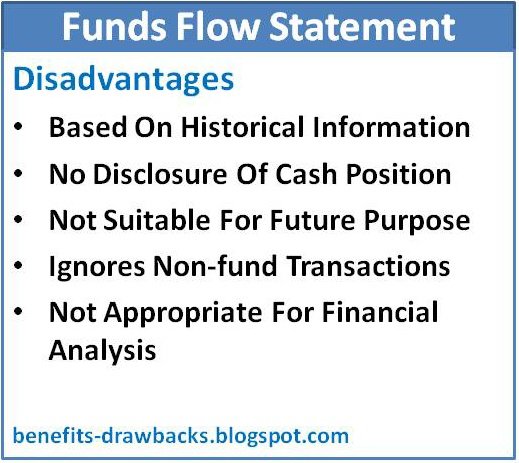
Disadvantages Of Funds Flow Statement

Some of the notable limitations or disadvantages of funds flow statement can be highlighted as follows:

1. Historical

Funds flow statement is historical in nature because past financial information are used to prepare it. Financial statements and balance sheets of previous period are the bases of funds flow statement. So, it cannot present accurate current position of the business.

2. Not Original

It is only the rearrangement of financial data of balance sheet, financial statement and the income statement. So, funds flow statement is not original as it cannot be prepared alone.

3. No Cash Position

Funds flow statement does not disclose the cash position of the firm, for which cash flow statement should be prepared separately. 
disadvantages funds flow statement
4. No Future Indication

It discloses past financial situation of the firm which may not be suitable for future purpose.

       Also Read:

5. No Non-fund Transactions

It ignores non-fund transactions such as purchase of assets or properties by issuing shares. It records only those transactions which directly affect working capital.

6. Not Suitable

Funds flow statement is not suitable for financial analysis.

Advantages Of Funds Flow Statement

The main benefits or advantages of funds flow statement can be highlighted as follows:

1. Source And Use Of Funds

Funds flow statement discloses the source of funds received by the firm and the areas where those funds are used.

2. Changes In Financial Position

It discloses the changes in financial position (increase or decrease in working capital) and explains the reasons for changes.

3. Allocation Of Resources

Funds flow statement helps in proper allocation of resources by providing key financial information and data to the management.
advantages funds flow statement
4. Evaluation Of Financial Position

It provides information regarding financial structure, fund generating capacity, position of assets and liabilities of the firm, working capital condition etc. which helps to know the actual financial position of the firm.

5. Future Guidance

Funds flow statement provides past financial data and information to the management. It helps the top level management to make future financial policies and plans.

      Also Read:

6. Use Of Working Capital

Funds flow statement checks the proper use of working capital and gives suggestions to improve.

7. Image And Goodwill

It ensures proper allocation of resources and proper use of working capital which increase the productivity and profitability of the firm. So, it helps to maintain good image and goodwill among shareholders.

Advantages Of Flexible Budget

Some of the notable benefits or advantages of flexible budget can be pointed out as follows:

1. Range Of Activity

Generally, static budget is prepared for single level only, but flexible budget is prepared for a range of activity. This is one of the major advantages of flexible budget.

2. Easy Comparison

Flexible budget helps to compare actual output, cost or performance with standard or budgeted output, cost and performance.

3. Cost Control

It can be used as a effective tool for cost control because flexible budget reacts to adverse situation.

Static budget is based upon assumptions, judgment, estimates and approximations. But flexible budget is prepared on the basis of knowledge and principles.

5. Flexibility

It is more flexible than static budget. It can be modified or changed according to the market situation and environment.

6. Performance Measurement

Flexible budget helps to measure managerial and operational performance.

Disadvantages Of Budgeting

Major limitations or disadvantages of budgeting can be pointed out as follows:

1. Based On Estimation

Budget is prepared on the basis of approximation, estimates, assumptions and judgment. So, it may lack accuracy and reliability.

2. Cost And Time Consuming

It takes more time, effort and cost to prepare budget for large sized organizations.

3. Less Flexibility

It is less flexible in nature and cannot be changed easily according to the market situation and environment.

Budgeting may demotivate employees due to the lack of participation. It may create behavioral problems. 

5. Conflict

There is a high chance of conflict because of lack of coordination among employees and coordination between, units, departments and branches.

Advantages Of Budgeting

The main benefits or advantages of budgeting can be pointed out as follows:

1. Goal Achievement

Budgeting provides guidelines to achieve operational and financial goals of the organization.

2. Better Coordination

It helps to maintain better coordination by linking organizational objectives and available resources in order to achieve the goal.

3. Guidelines

Budgeting provides guidelines or road map for better performance.

4. Better Decision Making

Budgeting helps the management to take wise decisions by providing proper guidelines and direction.

5. Resource Utilization

It promotes proper utilization of resources (material, labor and capital) to increase productivity and profitability.

6. Motivation

It motivates the management and employees which leads to better performance and job satisfaction.

7. Performance Evaluation

It helps to evaluate the performance of different units, departments and employees in the organization.

It helps to maintain better communication between the management and the subordinates.

9. Increase Efficiency

Because of motivation, coordination and better decision making, it helps to increase efficiency of the organizational activities. 

10. Corrective Action

It regularly monitors the progress of organizational activities and provide tool for corrective action when needed.