Advantages And Disadvantages Of Decentralized Stores

Merits Or Advantages Of Decentralized Stores

The main advantages of decentralized stores can be expressed as follows:

1. Lower Cost

Stores are maintained near to the production area which helps to eliminate internal transportation cost and also minimizes material handling cost.

2. Less Risk

In centralized store, there is a risk of loss by fire, rain, earthquake etc. because of large volume of materials in single warehouse. But in centralized store, less volume of stock are kept according to the requirement of the single production unit which lowers the risk of loss.

3. Avoidance Of Undue Delay

In this storing system, purchasing, storing and supplying of materials are done by each production unit. So, delay in material supply can be avoided which eliminates disruption in the production process.

4. Better Control And Supervision

Each and every production center and department has separate store. It ensures better control, supervision and handling of goods.

     Also Read: 

5, Suitability

Decentralized stores are suitable for large sized manufacturing companies with large production capacity, several branches, and departments.

Demerits Or Disadvantages Of Decentralized Stores

The main drawbacks, limitations or disadvantages of decentralized stores can be expressed as follows:

1. High Investment

It requires separate space for each and every production units and departments. So, more initial investment is required to set up these types of stores.
advantages disadvantages decentralized stores
2. Higher Cost

More staffing cost, administrative costs and supervision costs are required to manage decentralized stores. So, it is more costlier than centralized store.

3. Not Suitable

Decentralized store is not suitable for small business firms with less investment and less production capacity.

Pros And Cons Of Decentralized Stores In Short

Pros:
- It lowers material handling costs
- It becomes easy to store and control materials
- It is suitable for large manufacturing firms
- It avoids delay in supply of materials
- It eliminates internal transportation cost

Cons:
- It is not appropriate for small companies
- It requires more staffing, administrative and controlling costs than centralized stores
- More initial investment is required to set up decentralized stores

Advantages And Disadvantages Of Centralized Stores

Merits Or Advantages Of Centralized Stores

The main advantages of centralized stores can be expressed as follows:

1. Economical

In centralized store, materials are kept only in one warehouse. More goods can be stored in single location that minimizes inventory costs, administrative costs and handling costs. So, it is economical than decentralized stores.

2. Better Control And Supervision

Because of single location and less storage space, it is easier for the storekeeper to inspect, supervise and control inventory properly.

3. Wastage Minimization

Because of proper supervision and tight control misuse and wastage can be minimized. Wastage minimization leads to decrease in the cost of production which helps to increase profitability of the business.

4. Safety

Centralized store ensures safety of goods because of better layout, better supervision and better store audit.

advantages disadvantages centralized stores

5. Fewer Employees

These stores can be managed by fewer specialized employees.

     Also Read: 

6. Suitable For Small Firms

Centralized store is suitable for small and medium sized companies with less production units and departments.

Demerits Or Disadvantages Of Centralized Stores

The main drawbacks or disadvantages of centralized stores can be expressed as follows:

1. High Transportation Cost

Materials are supplied to different departments, branches and production units from single store. Therefore, it requires extra transportation and handling costs.

2. Chance Of Delay

Sometimes production centers cannot receive required materials on time because of delay in supply. In this situation production process may be interrupted.

3. Risk Of Loss

In centralized stores, large volume of stock are kept in single location. It increases the risk of loss by flood, earthquake, fire etc. There also exists a risk of obsolescence.

4. Unsuitable

These type of stores are not suitable for big manufacturing companies with several production units, branches and departments.

Pros And Cons Of Centralized Stores In Short

Pros:
- It reduces storing, material handling and supervision costs
- There is better supervision and store audit
- It is suitable for small manufacturing companies
- It minimizes staffing and stationary costs
- It helps to minimize the wastage of materials
- It requires less space for storing goods

Cons:
- It is not suitable for big manufacturers
- There is a possibility of delay in supply of materials
- There is a high risk of obsolescence
- It requires more transportation cost

Advantages And Disadvantages Of Decentralized Purchasing

Merits Or Advantages Of Decentralized Purchasing

The main advantages of decentralized purchasing system can be expressed as follows:

1. Less Investment

In decentralized purchasing system, branches or departments can buy materials according to their needs and requirements. It does not require huge initial investment like in centralized purchasing.

2. Right Quality And Quantity

Materials are purchased to fulfill the current needs of the department or branch. In this procurement system, only required materials are purchased that ensures right quantity and quality.

3. Quick Process

Because of prompt buying decision, quick purchase orders and local suppliers, this process is easier and quicker than centralized procurement.

4. Easy Replacement

Defective materials can be replaced immediately in decentralized procurement system.

5. Better Relation With Local Supplier

Branches purchases their needed materials from local market which helps to establish better relation with local suppliers or sellers.

    Also Read: 

6. Smooth Functioning

Materials can be obtained locally at any time without any difficulty. Because of easy and quick procurement process organizational activities can be run smoothly without any delay.

7. Suitable For Large Companies

This purchasing system is suitable for large manufacturing companies with several branches and departments.

Demerits Or Disadvantages Of Decentralized Purchasing

The main drawbacks or disadvantages of decentralized purchasing system can be expressed as follows:

1. High Purchasing Cost

In this purchasing system, company cannot enjoy the benefit of economies of scale. It may lose cash discount and quantity discount because of less quantity purchasing. So, purchase price of materials becomes high.

2. Knowledge Of Buying Staff

Decentralized purchase depends on the knowledge, skills and specialization of buying staff. Lack of appropriate knowledge and skills of staff may lead to over or under purchasing and may lack proper control and supervision of materials or inventory.
advantages disadvantages decentralized purchasing
3. Not Suitable For Small Firms

This procurement system is not suitable for small and medium sized companies with less investment, less production capacity, fewer branches and less operational activities. 

Pros And Cons Of Decentralized Purchasing In Short

Pros:
- It does not require huge initial investment
- Goods can be purchased in right quantity as per the requirement
- It is easy and quick purchasing process
- It is applicable for large companies having several branches and units
- Purchasing decisions can be made quickly

Cons:
- It is not appropriate for small business firms
- Company does not enjoy the benefit of bulk buying
- There exists a possibility of over or under purchasing of goods due to the lack of knowledge of staff.

Advantages And Disadvantages Of Centralized Purchasing

Merits or Advantages Of Centralized Purchasing

The main advantages of centralized purchasing can be expressed as follows:

1. Lower Purchase Price

In centralized purchasing, materials are purchased by central department. So, company can enjoy the benefit of economies of scale, cash discount and quantity discount. Bulk buying also reduces ordering and carrying costs that lowers the purchase price of materials.

2. Better Supervision And Control

It eliminates recklessness, overlapping and duplication in the process of purchasing. It ensures uniform procurement and effective storing of materials. So, centralized purchasing helps to establish better material supervision and control system in the organization.

3. Systematic Recording

All buying functions are performed through purchase department which is properly managed by procurement manager and skilled buying staffs. So, material related records (purchasing, supply, inventory etc.) can be properly and systematically.

4. Better Relationship

It helps to maintain better relationship with suppliers/sellers which increases the bargaining power. It is also helpful at the time of shortage and emergency.

    Also Read: 

5. Relief To The Managers

All the materials are purchased and supplied by a purchase department. Managers of other branches, departments and units do not have purchasing responsibility. So, they can focus on their main duties and responsibilities.

Demerits Or Disadvantages Of Centralized Purchasing

The main disadvantages of centralized purchasing can be expressed as follows:

1. Requirement Of High Investment

The main drawback of centralized purchasing is that it requires huge amount of initial investment to purchase materials for all branches and departments. 

2. Complexity

It is very difficult to purchase and supply materials to different branches and departments according to their needs and requirements. Buying staff cannot handle purchasing activity properly if the organization is very large with  several branches located at different geographical regions. So, this procurement is more complex than decentralized purchasing.

3. Chance Of Delay

In this system, procurement process is longer than decentralized purchasing. So, it is difficult for the branches to receive materials in time.
advantages disadvantages centralized purchasing
4. Not Suitable For Large Companies

It is not suitable for large companies with many branches located far from the headquarter.

5. Emergency Situation

Branches and departments are not allowed to purchase materials from local market. So, organizational activities can be delayed at the time of emergency because of the shortage of materials.

Pros And Cons Of Centralized Purchasing In Short

Pros:
- It minimizes purchasing price because of large scale buying and less carrying costs
- It ensures supervision and better material control system
- It eliminates recklessness and duplication in purchasing
- Inventory records can be maintained properly and systematically
- It maintains better relationship with seller

Cons:
- It requires high initial investment
- It is not suitable for large firms having several departments and branches because there is a chance of delay in receiving materials
- It will be difficult to replace defective materials
- This procurement system is not suitable at the time of emergency

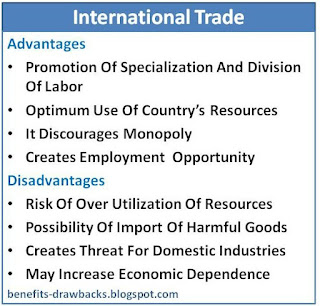
Advantages And Disadvantages of International Trade

Benefits Or Advantages Of International Trade

Some of the major advantages of international trade are as follows:

1. Promotes Specialization And Division Of Labor

International trade encourages the country to produce unique and quality products that can be easily exported in foreign countries. It requires specialization and division of labor for innovation and production of quality goods at lower price. So, it promotes specialization and division of labor.

2. Maximum Utilization Of Resources

Countries produce goods according to their available resources like natural resources, technological resources, financial resources etc. So, it helps to utilize country's resources properly.

3. Availability Of Products

Necessary goods can be imported from other countries to fulfill the demand of domestic country. So, international trade helps to obtain required products to satisfy country's demand.
4. Elimination Of Monopoly

Foreign trade discourages monopoly in the market because required commodities can be easily imported and surplus products can be exported in different countries. So, traders have no chance to create monopoly.

advantages disadvantages international trade

5. Industrial Development

Raw materials, technology, machinery and skills can be acquired from abroad because of international trade. This promotes industrial development in the country.

6. Lower Cost

International trade promotes specialization, division of labor and optimum utilization of resources by which large scale production with minimum wastage and leakage is possible. So, it helps to lower the cost of production.

7. Employment Opportunity

Because of international trade, large scale industries are established in the country. So, many people get job in the country. So, it creates employment opportunity.

Drawbacks Or Disadvantages Of International Trade

The main disadvantages of international trade are as follows:

1. Threat To Domestic Industries

Foreign trade may create threat to domestic industries because of the import of cheap products. Small industries may suffer due to unfair competition with big foreign companies.

2. Over Exhaustion Of Resources

Unrestricted export of minerals and raw material may lead to exhaustion of resources in the country. This may create environmental, social and economic problems in the future.

3. Shortage Of Goods

Producers try to export more products to expand market share and to earn more profit. This may create shortage of good in the domestic market.

4. Supply Of Harmful Products

Due to international trade, harmful goods may be imported in the country. Supply of these products in local market may effect people's health. Import of unnecessary goods negatively effects the economy.

Pros And Cons Of International Trade In Short

Pros:
- Ensures Maximum Use Of Country's Resources
- It helps to eliminate monopoly in the market
- It helps to bring specialization in the production process
- It minimizes the cost of production because of large scale production
- It generates employment opportunity because of industrial development in the country

Cons:
- High possibility of over exhaustion of natural resources
- It may create threat for domestic industries because of unfair competition
- Increases the risk of import of inferior and harmful products 
- It may increase economic dependence due to the loss of self sufficiency

Importance Or Advantages Of Office Management

Importance and advantages of office management can be expressed as follows:

1. Goal Attainment

Office management directs the efforts of all staffs (top level to bottom level) towards the achievement of company's goals and objectives. Planning, organizing, coordinating, directing and controlling are the major functions of management which helps to achieve organizational goals effectively.

2. Smooth Functioning

It maintains proper balance and relationship between staffs, jobs, departments and units. Effective communication is maintained between one person to another person, one department to another department and one job to another job. Proper command, direction, supervision, and instructions are supplied to ensure smooth functioning of office activities.

3. Optimum Utilization Of Resources

Office management always tries to utilize available resources like human resources, physical resources, financial resources and technological resources in proper way that helps to increase productivity and decrease wastage and unnecessary costs.

4. Better Coordination

Better coordination is required to link different office activities, departments and people in the organization. Office management maintains unity of action, proper communication and harmony by using different coordination mechanisms.

5. Cost Minimization

Office management encourages better utilization of resources, effective communication, better coordination and employee motivation in the office. It helps to increase productivity and reduce wastage, leakage that minimizes the cost of production. Reduction in the cost of production helps to increase profitability of the business.
advantages of office management
6. Goodwill And Public Relation

Office works are performed effectively and smoothly because of better management. Motivated employees can deal properly with customers and public. It helps to increase goodwill and maintain public relations.

7. Promotion Of Leadership

Office management provides good working environment in the office. Authority and responsibility are delegated according to the skill, qualification and capability of employees. Top level managers use their skills to motivate others for better performance so employees can develop leadership and managerial qualities.