Advantages And Disadvantages Of Monopoly

Benefits Or Advantages Of Monopoly

The main advantages of monopoly can be described as follows:

1. Supernormal Profit

In monopoly, there is only one supplier for the entire market. Company can set selling price of goods freely as per wish. Therefore, monopolies can make supernormal profit.

2. Economies Of Large Scale

Only one company sells products to the large number of customers. Because of large volume of production and less cost of production firm enjoys the benefit of economies of large scale.

3. Government Revenue

Companies earns massive amount of profit because of monopoly. So, government can collect more tax from them. So, monopolies are good source of government revenue.

4. Price Discrimination

Price discrimination is another benefit of monopoly. Company may use this policy to benefit economically backward customers. For example, electricity authority may provide discount to poor families.

5. Research And Development

Company makes massive profit because of lack of competition in the market. So, it can invest huge amount of money for research and development activities. It helps to improve product quality and also minimizes the cost of production.

      Also Read: 

6. Promotes Innovation

Because of huge investment in research and development, monopoly promotes innovation also.

7. Face Depression

Because of being single supplier of goods and services, economic crisis like depression does not affect monopolies or company can face depression easily.
Drawbacks Or Disadvantages Of Monopoly

The main disadvantages of monopoly can be described as follows:

1. Customer Exploitation

Single seller has absolute power of setting price and supplying goods in the whole market. It may sell low quality products at higher price. So, there exists a chance of exploitation of customers in monopoly market.

2. Poor Service

Being a single trader, company may focus only on earning more profit rather than providing good service to the customers. Because of no customer sovereignty, consumers may not get quality products and proper service.

3. No Choice

Customers have no choice because there is only one supplier for whole market.

4. Higher Price

Monopoly lacks competition because there is one supplier for all customers. So, company may charge higher price for low quality products. 

5. Unfair Practice

Monopoly restricts others to enter the market. New firms cannot sell their products in this market structure. So, it is an unfair trade practice.
advantages disadvantages of monopoly
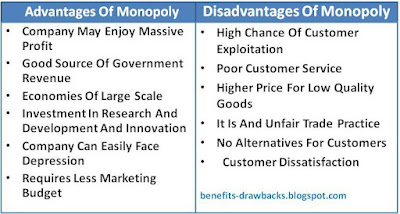
Pros And Cons Of Monopoly In Short

Pros:

- Business Firms can earn massive profit
- Companies enjoy economies of scale because of large volume of production
- Requires less marketing and promotion costs
- It encourages innovation, research and development
- Government can collect more tax from monopoly firms

Cons:

- Customers have to pay higher price for inferior products due to the lack of competition
- It lacks customer sovereignty
- Because of single supplier, there is no alternatives for customers
- It may increase customer dissatisfaction

Advantages And Disadvantages Of Monopolistic Competition

Benefits Or Advantages Of Monopolistic Competition

The main advantages of monopolistic competition can be described as follows:

1. Easy To Enter And Exit

The main benefit of monopolistic competition market structure is that new firm can enter the market without any barriers. Traders can exit or leave the market at any time without any restrictions and obstacles.

2. Product Differentiation

In this type of market, products are differentiated or varieties of products are available. So, it provides selection facility for buyers.

3. Advertising

In monopolistic market, products are identical or homogeneous like in perfect competition. So, firms advertise their products through different media which helps to provide information about quality, price and using methods to the customers.

4. More Profit

Companies are free to set price of their products. So, they can set higher price of goods and services which generates more profit.

    Also Read: 

5. Better Quality

Because of the ability to fix price and chance of more revenue, companies try to improve product quality. It helps to retain existing customers and attract potential customers.

6. Innovation

Monopolistic competition encourages innovation. Companies regularly perform research and development activities to add new features to their products which helps to increase quality and value.

Drawbacks Or Disadvantages Of Monopolistic Competition

The main disadvantages of monopolistic competition can be described as follows:

1. Higher Price

In this type of market, product price is higher than perfect competition because of the following reasons:
* Firm can set price itself
* Firm invests huge amount of money in advertisement and other promotional activities
* Wastage of resources such as excess packaging, marketing etc. 

So, customers have to pay more money in monopolistic market.

2. Misleading Customers

Various promotional activities are conducted to provide information about the products and services. Sometimes wrong information can mislead the customers.
advantages disadvantages monopolistic competition
3. No Economies Of Scale

Because of larger number of traders, all companies cannot enjoy the benefit of economies of scale.

Pros And Cons Of Monopolistic Competition In Short

Pros:

- Customers get selection facility because of different alternatives
- Companies can easily enter or exit the market because of less barriers
- Customers get detail information about the products or services
- It promotes innovation
- Because of competition customer get quality products at lower price

Cons:

- Price of the product may become high because of high marketing budget
- There is no economies of scale
- False information about products may mislead customers

Advantages And Disadvantages Of Perfect Competition

Merits Or Advantages Of Perfect Competition

The main benefits or advantages of perfect competition can be described as follows:

1. Easy Entry And Exit

In perfect competition, business firms or traders can enter the market and start business without any restrictions. They can exit or leave the market at any time without any obstacles. So, there is no entry and exit barriers in this type of market structure.

2. Lower Price

In this type of market, price of product or service is fixed by demand and supply mechanism. If any trader charges higher price then customers are free to buy products from another shop. So, consumers can fulfill their requirements at lower price.

3. No Consumer Exploitation

Due to competition, customers can get standardized products at affordable price because sellers cannot influence the market. Therefore, perfect competition discourages consumer exploitation.

4. Less Promotional Cost

As we know that this market structure deals with homogeneous products and price is fixed by the market mechanism, producers do not need to invest huge amount in advertisement, publicity and other promotional activities.

5. Optimum Utilization Of Resources

Because of lower price, firms earn less profit. Therefore they try to increase efficiency and minimize wastage by utilizing resources properly which helps to lower the cost of production.

Demerits Or Disadvantages Of Perfect Competition

The main drawbacks or disadvantages of perfect competition can be described as follows:

1. Less Profit

It is very difficult for small traders to sustain in the market because of the lack of incentive and lower profit margin.

    Also Read: 

2. Limited Choice

This market deals with identical or homogeneous products and services. Therefore there is a limited choice for customers. Because of the lack of variety, customers have no selection facility.

3. No Economies Of Scale

There are various firms trading similar types of products. So, business firms cannot enjoy the benefit of economies of large scale. 
advantages disadvantages of perfect competition
Pros And Cons Of Perfect Competition In Short

pros:
- It discourages customer exploitation
- It creates active business environment
- There are no restrictions to enter or exit the market
- Customers get high quality products at reasonable price
- Producers focus on maximum utilization of resources to improve efficiency
- It requires less advertising and publicity budget

cons:
- It is difficult for small traders to sustain because of high competition
- It lacks product differentiation
- Firms cannot enjoy the benefit of economies of scale
- In this market, profit margin is very low. So producers cannot make sufficient investment for research and development purpose.
- Customers get limited choice

Advantages Of Marketing

Roles, importance or advantages of marketing can be described from customer's, business firm's and society's point of view as follows:

Benefits Of Marketing To Customers

The main advantages of marketing to customers can be studied as follows:

1. Need Satisfaction

As we know that the main objective of marketing is to satisfy customers by producing and supplying goods and services as per their needs or wants. So, marketing is important to fulfill needs and to provide satisfaction to the customers.

2. Providing Information

Marketing uses different methods and techniques such as advertising, sales promotion, publicity etc. to inform potential customers about the quality, taste, price, using methods and uses of products and services. So, it helps to provide information to the customer before buying goods.

3. Selection Facility

In market, we can find similar types of products produced by different firms. Marketing helps to identify the brand and select products according to their needs and interest. 

4. Improve Lifestyle

Marketing promotes better lifestyle by providing quality goods and services at affordable price. So, it helps to improve the living standard of the people.
 
Benefits Of Marketing To Business Organizations

Marketing is important or advantageous for business firms because of the following reasons:

1. Increase Production

Business firms uses different marketing techniques (advertising, sales promotion, public relation etc.) to enlarge the market. It helps to find new market and new demand for their products. So, marketing helps to increase production.

2. Revenue Generation

In any business company, there are different departments or functional areas such as production department, human resource department, accounting department, administrative department and marketing department. Among these departments only marketing generates revenue for the company. So, marketing activities are important to earn profit for the firm.

3. Planning And Decision Making

Marketing provides useful data and information about market, customers behavior, competitors, government policy etc. to the management. So, it helps the manager in planning and decision making process.

4. Increase Goodwill And Image

Marketing always tries to satisfy customers by providing goods and services according to their needs and wants at lower price. Satisfied customers become loyal to the company which helps to improve goodwill and image of business firm.
advantages of marketing
Benefits Of Marketing To The Society

Advantages of marketing to the society or nation can be explained as follows:

1. Economic Development

Marketing promotes productivity and efficiency which leads to maximum utilization of resources (natural resources, physical resources, finance resources etc.) in the country. Proper utilization of resources, better productivity and efficiency help to increase national income which helps in the economic development of the nation.

2. Employment Opportunities

Marketing promotes industrialization in the country. It generates employment opportunities in different ares such as research and development, production, promotion, distribution etc. So, it is very important to create employment opportunities in the country.

3. Rise In Standard Of Living

Marketing provides better quality products at lower price to the customers which helps to improve their lifestyle. It provides employment opportunities and helps to break vicious poverty circle in the society. So, it raises the living standard of the people.

4. Utility Creation

Marketing creates time utility (storage), form utility (product development), place utility (transportation), and possession utility (exchange) of products or services.

Advantages And Disadvantages Of Decentralized Stores

Merits Or Advantages Of Decentralized Stores

The main advantages of decentralized stores can be expressed as follows:

1. Lower Cost

Stores are maintained near to the production area which helps to eliminate internal transportation cost and also minimizes material handling cost.

2. Less Risk

In centralized store, there is a risk of loss by fire, rain, earthquake etc. because of large volume of materials in single warehouse. But in centralized store, less volume of stock are kept according to the requirement of the single production unit which lowers the risk of loss.

3. Avoidance Of Undue Delay

In this storing system, purchasing, storing and supplying of materials are done by each production unit. So, delay in material supply can be avoided which eliminates disruption in the production process.

4. Better Control And Supervision

Each and every production center and department has separate store. It ensures better control, supervision and handling of goods.

     Also Read: 

5, Suitability

Decentralized stores are suitable for large sized manufacturing companies with large production capacity, several branches, and departments.

Demerits Or Disadvantages Of Decentralized Stores

The main drawbacks, limitations or disadvantages of decentralized stores can be expressed as follows:

1. High Investment

It requires separate space for each and every production units and departments. So, more initial investment is required to set up these types of stores.
advantages disadvantages decentralized stores
2. Higher Cost

More staffing cost, administrative costs and supervision costs are required to manage decentralized stores. So, it is more costlier than centralized store.

3. Not Suitable

Decentralized store is not suitable for small business firms with less investment and less production capacity.

Pros And Cons Of Decentralized Stores In Short

Pros:
- It lowers material handling costs
- It becomes easy to store and control materials
- It is suitable for large manufacturing firms
- It avoids delay in supply of materials
- It eliminates internal transportation cost

Cons:
- It is not appropriate for small companies
- It requires more staffing, administrative and controlling costs than centralized stores
- More initial investment is required to set up decentralized stores

Advantages And Disadvantages Of Centralized Stores

Merits Or Advantages Of Centralized Stores

The main advantages of centralized stores can be expressed as follows:

1. Economical

In centralized store, materials are kept only in one warehouse. More goods can be stored in single location that minimizes inventory costs, administrative costs and handling costs. So, it is economical than decentralized stores.

2. Better Control And Supervision

Because of single location and less storage space, it is easier for the storekeeper to inspect, supervise and control inventory properly.

3. Wastage Minimization

Because of proper supervision and tight control misuse and wastage can be minimized. Wastage minimization leads to decrease in the cost of production which helps to increase profitability of the business.

4. Safety

Centralized store ensures safety of goods because of better layout, better supervision and better store audit.

advantages disadvantages centralized stores

5. Fewer Employees

These stores can be managed by fewer specialized employees.

     Also Read: 

6. Suitable For Small Firms

Centralized store is suitable for small and medium sized companies with less production units and departments.

Demerits Or Disadvantages Of Centralized Stores

The main drawbacks or disadvantages of centralized stores can be expressed as follows:

1. High Transportation Cost

Materials are supplied to different departments, branches and production units from single store. Therefore, it requires extra transportation and handling costs.

2. Chance Of Delay

Sometimes production centers cannot receive required materials on time because of delay in supply. In this situation production process may be interrupted.

3. Risk Of Loss

In centralized stores, large volume of stock are kept in single location. It increases the risk of loss by flood, earthquake, fire etc. There also exists a risk of obsolescence.

4. Unsuitable

These type of stores are not suitable for big manufacturing companies with several production units, branches and departments.

Pros And Cons Of Centralized Stores In Short

Pros:
- It reduces storing, material handling and supervision costs
- There is better supervision and store audit
- It is suitable for small manufacturing companies
- It minimizes staffing and stationary costs
- It helps to minimize the wastage of materials
- It requires less space for storing goods

Cons:
- It is not suitable for big manufacturers
- There is a possibility of delay in supply of materials
- There is a high risk of obsolescence
- It requires more transportation cost