Advantages And Disadvantages Of Internal Audit

Merits/Benefits Or Advantages Of Internal Audit

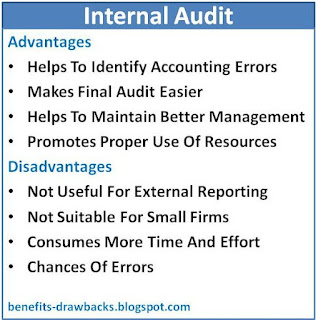
The main advantages of internal audit can be highlighted as follows:

1. To Discover Errors And Frauds

One of the main benefits of internal audit is that helps to discover accounting errors and frauds so that they can be rectified before the final audit.

2. To Maintain Proper Accounting

It helps to maintain proper accounting system in the organization. It ensures accuracy and authenticity of accounting records.

3. Provides Base For Final Audit

Internal audit examines and verifies entire books of accounts and locate mistakes and frauds. So, conduction of final audit becomes easier.
4. Increase Employees Efficiency

Internal audit alerts the staffs by checking their performance regularly. It helps to increase their efficiency and also helps to minimize errors.

5. Proper Utilization Of Resources

Internal audit ensures proper utilization of resources by detecting their misuse. It helps to increase operational efficiency and productivity.

advantages disadvantages internal audit

6. Valuable Suggestions

It gives suggestions and instructions regarding the financial and operational activities of the organization. So it helps to maintain better management, proper supervision and effective control.

Disadvantages/Drawbacks Or Demerits Of Internal Audit

Some of the notable disadvantages of internal audit can be highlighted as follows:

1. Not Suitable For Small Firms

Internal audit is not suitable for small business organizations with less financial and operational activities.

2. Not Acceptable

It is conducted for internal purpose only. It is not accepted by shareholders and other external users.

      Also Read:

3. Chance Of Errors

There may be a chance of errors because of the poor knowledge of the audit staff.

4. Time Consuming

It takes a long time to perform internal auditing. It may disturb regular office work.

Pros And Cons Of Internal Audit In Short

Pros:
- It detects frauds, mistakes and loopholes in the accounting system
- It makes easier to conduct final audit
- It helps to improve operational efficiency
- It provides useful information and suggestions to the management
- It is suitable for big business organizations

Cons:
- It is not useful for external reporting
- It consumes more time and effort which may hamper routine activities in the firm
- It is not suitable for small organizations having limited number of financial activities
- It may lack accuracy because of limited knowledge of internal audit personnel

Advantages And Disadvantages Of Management Audit

Merits Or Advantages Of Management Audit

The main advantages of management audit can be studied as follows:

1. Helps In Structural Improvement

Management audit examines the functions of management and identifies the strength and weakness in management process. So, it helps to improve organizational structure according to the plans and policies of the firm.

2. Provides Valuable Suggestions

After reviewing the defects and deficiencies, it provides appropriate suggestions which helps to increase management efficiency.

3. Utilization Of Resources

Management audit helps in proper utilization of organizational resources to achieve predetermined goals and objectives.
advantages disadvantages management audit
4. Helps In Decision Making

It helps the management to take various decisions such as make or buy, sell or process further, special order, drop or continue decision etc.

5. Increase Profitability

Management audit helps to increase profitability of the firm by minimizing wastage and by utilizing resources properly. 

Demerits Or Disadvantages Of Management Audit

Some major disadvantages of management audit can be highlighted as follows:

1. Expensive System

Management audit is a costly method of auditing. So, it is not suitable for small firms having limited resources.

     Also Read:

2. Not Well-defined

Management audit lacks fixed methods and techniques of auditing. So, it is not well defined.

3. Not Suitable

Management audit provides only theoretical suggestions to the management which are not suitable or applicable to solve practical problems. 

Advantages And Disadvantages Of Interim Audit

Advantages Or Merits Of Interim Audit

The main advantages of interim audit can be discussed as follows:

1. Less Expensive

Interim audit is less costly than continuous audit.

2. Suitable For Big Firms

Interim audit is very suitable for large and dynamic type of business organizations.

3. Helpful For Final Audit

Final audit can be conducted in short time because of interim audit.

4. Early Detection Of Errors

Errors and frauds can be located before the final audit. It helps to correct such errors and frauds in time.

5. Moral Check

It creates moral pressure on the employees to perform accounting jobs effectively. It also helps to eliminate mistakes and frauds.
advantages disadvantages interim audit
6. Interim Dividend

A firm declares interim dividend after conducting interim audit.

Disadvantages Or Demerits Of Interim Audit

The main disadvantages of interim audit can be studied as follows:

1. Alteration Of Figure

Already audited accounting figure may be changed by a dishonest employee. It may create difficulty in final audit.

2. Work Burden

Audit notes have to be prepared after the completion of interim audit. It increases the burden of work.

3. Unsuitable For Small Firms

Interim audit is not suitable for small business organizations with less financial transaction.

      Also Read:

4. Disturbance At Work

Interim audit disturbs the working environment in the office. Regular office activities may be hampered because of audit work.

5. Increase Expenses

Interim audit increases the expenses of the business.

Pros And Cons Of Interim Audit In Short

Pros:
- It consumes less cost and time
- Errors and frauds can be detected quickly
- It makes final audit easier
- It is suitable for big firms to publish interim figures

Cons:
- It may disturb regular office work
- There is a possibility of falsification of financial figures by dishonest employees
- It is not suitable for small business firms
- It increases the work load of audit staff

Advantages And Disadvantages Of Final Audit

Merits Or Advantages Of Final Audit

Main advantages of final audit or periodical audit can be highlighted as follows:

1. Suitable For Small Firms

Final audit is very suitable for small business concerns with less number of business transactions and resources.

2. Low Cost

Periodical audit or final audit is conducted after the end of every financial year. So, it takes less cost and effort than continuous audit.

3. No Alteration Of Figure

Periodical audit is conducted only after the completion of entire accounting works. So, there is no chance of alteration or manipulation of figures.

4. No Disturbance At Work

In continuous audit, auditor frequently visits the office which may disturb the working environment. But in periodical or final audit auditor visits office only at the end of the accounting period. So, final audit does not hamper regular office work.

5. Reasonable Time

Final audit takes less time than continuous audit because auditing can be performed continuously without break.

6. True Profit Or Loss

Final audit examines the profit and loss account of the company which helps to know the true profit or loss of the business.

7. True Financial Statement

Balance sheet is properly checked by the auditor at the end of every year. It helps to know the actual financial position of the business.

8. Increase Goodwill

Periodical audit provides up-to-date information about profit, loss, financial position of the business. It helps to increase goodwill and image of the business.

Disadvantages Or Demerits Of Final Audit

Major drawbacks or disadvantages of final or periodical audit can be highlighted as follows:

1. Chance Of Error

Final audit is conducted only once in a year. So, books of accounts cannot be examined and verified properly. Due to the lack of in-depth checking there is a chance of leaving errors while conducting audit work.
advantages disadvantages final audit
2. Shortage Of Time

It is very difficult to conduct the audit of whole year in a given time frame.

3. Not Suitable For Large Companies

It is not suitable for large business companies with large volume of transactions and resources.

      Also Read:

4. Low Moral Check

In periodic or final audit, auditor does not visit clients' office frequently. So, staffs may feel free to commit frauds and errors because of no moral pressure.

Pros And Cons Of Final Audit In Short

Pros:
- It takes less cost, time and effort than continuous audit
- It shows actual profit or loss and financial health of the company
- It provides financial data and information to both internal and external users of accounting information
- It does not disturb regular organizational activities
- It improves the image and goodwill of the firm

Cons:
- It is difficult to detect planned errors and frauds
- There is a possibility of misrepresentation of financial data
- It will be difficult for the auditor to finish auditing task in limited time

Disadvantages Of Continuous Audit

Main disadvantages or limitations of continuous audit can be expressed as follows:

1. Not Suitable For Small Business

One of the major drawbacks of continuous audit is that it is not suitable for small business firms having less numbers of financial transaction.

2. Inconvenience

It may disturb the working environment of the organization because of the frequent surprise visits of audit staffs. So, it is inconvenience system of audit.

3. High Expenditure

Continuous audit is very expensive form of audit because company has to pay high amount of audit fee frequently.
disadvantages continuous audit
4. Chance Of Alteration

There exists the chance of alteration of accounting figures after checking by the auditor. Alteration may be happened intentionally or unknowingly.

       
Also Read: 

5. Increased Dependency

Because of frequent auditing, client's staff becomes more dependent upon auditor's staff for simple problems and errors.

6. Staff Intimacy

Continuous audit establishes intimacy among the staff and auditor. This intimacy may lead to frauds.

Advantages Of Continuous Audit

Main advantages or merits of continuous audit can be pointed out as follows:

1. Quick Detection Of Errors

In continuous audit, books of accounts are checked and verified at regular interval throughout the financial year. It helps to locate accounting errors and frauds very quickly. Early detection of errors helps to rectify them sooner.

2. Useful For Large Organization

Continuous audit is very useful for large business organizations having the large number of financial transactions.

3. Quick Presentation Of Accounts

With the help of continuous audit, books of accounts can be examined and verified quickly. So, final audit report can be presented sooner.
advantages continuous audit
4. Avoids Missing Entries

Continuous audit helps to maintain proper and up-to-date records of every financial transaction. So, there will be no missing entries.
               
         Also Read: 

5. Regularity Of Staffs

Continuous audit gives moral pressure to the accounting staffs. They become regular because of regular visit of the auditor. It also motivates them to maintain proper accounts.

6. Elimination of Waste

Wastage and inefficiencies can be eliminated with the help of continuous audit. This helps to increase production and profit of the firm.