Advantages And Disadvantages Of Cluster Sampling

What Is Cluster Sampling ?

Cluster sampling is a type of sampling method where researchers divide the population into different groups or clusters to gather data and information. Clusters should be internally heterogeneous and externally homogeneous. By using this technique, large data samples can be created by consuming less resources and costs. It is more feasible to collect data and information than other sampling methods.


Benefits Or Advantages Of Cluster Sampling


The main advantages of cluster sampling method can be highlighted as follows:


1. It Consumes Less Time, Cost And Effort


The main benefit of cluster sampling is that it requires less time and effort than other methods of sampling. It consumes fewer resources (limited number of clusters), and fewer costs ( travelling expenses, listing expenses ,administrative expenses etc.). It can be conducted quickly in less time than random and stratified sampling.


2. Suitability


This sampling is suitable for large population and wider geographical area because sample size can be increased as per the requirement. It is applicable for market research and to collect data and information from different institutions.


3. Most Feasible Method Of Sampling


Another advantage of cluster sampling is that it is more feasible than random sampling because each and every individual within a cluster represents the entire population because the population is carefully divided into homogeneous groups.


4. Larger Data


Cluster sampling provides large data to the researcher because of large population group.


5. Easy Implementation Of Data


Data and information collected from cluster sampling can be implemented easily and quickly.


Drawbacks Or Disadvantages Of Cluster Sampling


The main disadvantages of cluster sampling can be highlighted as follows:


1. Complex Method


It is more complicated than random sampling because it requires proper plan and attention to choose clusters from large population.


2. Less Accuracy


It may lack statistical accuracy in case of biased samples, over-representation or under-representation of data, and carelessness of the researcher.


Limited clusters are selected from very large population and from wider geographical area. It increases the chance of high sampling error.


4. Not Suitable


It is not suitable for small group of population. Another disadvantage of this method is that findings obtained from one population does not apply on other similar groups from other population. 


Pros And Cons Of Cluster Sampling In Short


Pros:

- It consumes fewer resources such as time, expenses and effort
- This method is more feasible than other sampling approaches
- It is appropriate for large population group and wider geographical area
- Large data sample can be obtained


Cons:

- There is a high chance of sampling error
-  It is complex than other sampling methods
- It is not appropriate in case of small population
- It may lack accuracy

Advantages And Disadvantages Of Teamwork

What Is Team Work ?

When two or more people work together to complete a specific task or to achieve a common goal is called teamwork. It is known as the  collaborative effort of a group of people to perform a task. In simple words, team work can be defined as an activity of working together to obtain certain objective. It helps to simplify the complex tasks and reduces the workload, that helps to minimize errors and mistakes and increases the productivity.


Benefits Or Advantages Of Teamwork


The main advantages of teamwork can be explained as follows:

1. Teamwork Reduces Workload

The main benefit of teamwork is that it simplifies complex and difficult tasks and divides among the members according to their skills and capabilities. So, difficult tasks can be performed easily when there is a team. In this way, teamwork helps to reduce the workload of an individual with the means of division of labor and specialization.

2. Teamwork Increases Productivity

Suppose an individual can complete a task in 10 hours. But if it is performed by 5 people, it can be completed within 2 hours. It means more tasks can be completed if we work in a team. So, it helps to perform more tasks which leads to improve the productivity of the company.

3. Teamwork Provides Learning Opportunity


A team is a combination of different talents, different skills, different experience, different culture and different backgrounds. So, interaction among the members provides opportunity to learn new skills and gain knowledge which is very useful in personal growth and career development.

4. Better Quality Of Output


Another notable advantage of teamwork is that it ensures better quality of output. Because of division of work and specialization, minimization of errors, mistakes and wastage is possible. S, it helps to increase the quality of output. 

5. It Increases Employee Motivation And Morale


Teamwork decreases the workload which reduces the  burden and stress. It also provides learning opportunity that increases the skills and abilities. So, it helps to improve employee morale and motivation which leads to job satisfaction.

6. Teamwork Increases Interpersonal Skill


It promotes coordination and sense of commitment in the organization. Better coordination helps to improve communication and interpersonal skill of the employees.

7. It Encourages Innovation


Because of different minds and abilities, new idea and better solutions can be discovered to overcome the obstacles. So, teamwork promotes innovation.

Drawbacks Or Disadvantages Of Teamwork

The main disadvantages of teamwork can be expressed as follows:

1. Teamwork Lengthens Decision Making Process

One of the main drawbacks of teamwork is that it takes more time to make decisions. It requires the agreement of all members to make any decision. So, quick decision is not possible at the time of emergency.

2. High Chance Of Conflict


There exists a chance of conflict and misunderstanding between the team members. Conflict among the employees decreases the efficiency, disturbs the working environment and hampers the smooth flow of operation.

3. May Create Challenge To The Management


It may become difficult for the management assign tasks properly to the team, to handle conflict effectively and to evaluate employees' performance fairly.

advantages disadvantages teamwork

4. Demoralization Of Team

Possibility of demoralization is another disadvantage of teamwork. Unequal distribution of work, unequal participation in the job, difference in the interests and opinions of members and presence of conflict and misunderstanding may lead to demoralization.

5. Possibility Of Factionalism


Disputes and misunderstanding between the team members leads to factionalism in the workplace. Factionalism creates conflict which negatively affects the performance and productivity of the organization. 

Pros And Cons Of Teamwork In Short

Pros:

- It simplifies large and complex tasks into small pieces of works which helps to decrease the workload and burden of  team members . 

- It helps to improve productivity and quality of output.

- It increases interpersonal skills, motivation, morale and job satisfaction

- It provides learning opportunity to the members which helps to improve their skills and abilities.

- Because of higher motivation and job satisfaction, it helps to lower employee turnover rate.

Cons:

- There is a possibility of conflict and misunderstanding among the members and factionalism in the workstation.

-  It takes long time and effort to make decision

- It may be difficult for the management to maintain better discipline in the workplace.

- There will be a chance of personality clash among the team members. 

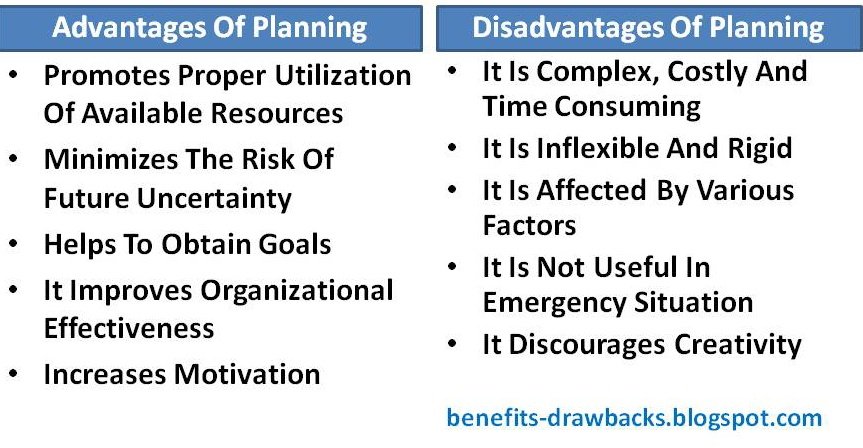
Advantages And Disadvantages Of Planning

Benefits Or Advantages Of Planning

The main advantages of planning can be expressed as follows:

1. It Helps To Achieve Organizational Goals

All organizational activities are directed towards the attainment of goals and objectives. Planning defines objectives and provide framework and road map, and procedures to achieve those goals and objectives. So, it is impossible for the organization to obtain specific goals without proper planning.


2. Planning Ensures Proper Utilization Of Available Resources


Optimum utilization of resources is another advantage of planning. To obtain predetermined goals, all resources (human resources, physical resources and financial resources) should be properly utilized. Planning promotes better utilization of resource which helps to achieve desired output.


3. It Reduces Uncertainty


Planning is futuristic in nature. It is done on the basis of past results and future prediction. Efficient management can make better plan by eliminating past mistakes and predicting possible future events wisely. So, it helps to lower the risk of uncertainty in the future.


4. It Helps To Maintain Coordination And Control


As we know that all the efforts are directed towards the attainment of specific goals.  So, available resources are properly applied in a coordinated manner. All the activities are done according to the plan. So, it makes proper coordination, discipline and control in the organization.


5. It Improves Employee Motivation


Employee motivation is another notable benefit of better planning. It sets clear goals and objectives that should be obtained in the future and employs human resources (workers) as per their skills and ability. which promotes specialization and division of work. So, it increases employees motivation in the organization.

6. Planning Minimizes Costs


Minimization of unnecessary cost is another notable advantage of planning. Because of better utilization of resources, effective control and coordination, efficiency and performance can be increased. It leads to increase in the production which decreases the cost of production. It also minimizes the wastage and idle time in the workplace. So, it brings economy by minimizing operational costs,


7. Helps To  Improve Organizational Effectiveness


Maximum utilization of resources, improved motivation , better control and cost minimization increases organizational effectiveness. 


8. Planning Avoids Duplication


All the activities are clearly defined and assigned to the concern unit, department, section or employees properly that helps to avoid duplication and overlapping. 


Drawbacks Or Disadvantages Of Planning


The main constraints or disadvantages of planning can be expressed as follows:


1. Planning Is Costly And Time Consuming 


Planning process consumes money , adequate time and effort. It takes time to collect past data and information. Experts services (with high salary and allowance) is required to analyze obtained data , to predict future situation and to compare different alternatives. So, it is complex, expensive and costly process.


2. It May Lack Accuracy


Planning depends on the historical data and future forecast. Because of the lack of correct data and uncertainty of future trend, it may lack accuracy and not give desired output or goals. So, lack of accuracy is one of the main disadvantages of planning.


3. Not Suitable For Emergencies And Crisis


Prompt decision and quick action is required at the time of emergency and crisis. But planning is a time taking process. So, it is not useful for such situations.

advantages disadvantages planning

4. It Is Influenced By External Factors

As we know that planning is dependent on future predictions and future is not certain. Changes in technology, changing government rules and regulations, change in market situation, natural calamities etc. may affect planning function.


5. Planning Is A Rigid Process


It is another disadvantage of planning that employees are forced to do their jobs as per the predetermined plan and policy of the organization. It may discourage freedom and creativity. There is less opportunity for personal development and growth. So, it is rigid and inflexible process.


Pros And Cons Of Planning In Short


Pros:

- It helps to achieve the goals and the objectives of the firms.

- It promotes optimum use of resources in the organization

- Proper planning helps to reduce risks and uncertainties

- It helps to minimize the operational costs

- It facilitates better coordination and control in the workplace

- It helps to increase motivation and employee satisfaction


Cons:

- It may become inaccurate because of the lack of reliable data and information

- It is costly, time consuming and rigid process

- Because of the lengthy decision making process, it is not suitable in the emergency situation

- It may discourage the creativity of the employees

- It lacks flexibility

Advantages And Disadvantages Of Leasing

Benefits Or Advantages Of Leasing

The main advantages of leasing can be described as follows:

1. It Promotes Entrepreneurship

While commencing a business it requires huge capital to purchase fixed assets such as land, building, machinery, plant etc. Leasing resolves this requirement by providing the right to use asset in exchange for periodic rental payment. So, leasing promotes entrepreneurship by minimizing initial cash outlay.


2. It Enhances Liquidity


Leasing saves huge amount of fund which increases liquidity of the firm. Saved fund can be used to fulfill working capital requirement or can be invested in other profitable activities.


3. It Provides Tax Benefit


A company can enjoy tax benefit because lease rental payments are operating expenses and deducted from taxable income. So, leasing saves costs.


4. Convenience Method Of Financing


Leasing is cheaper and convenience than other sources of financing. It does not require various steps and formalities like borrowing loan from banks and financial companies.


5. Suitable For Small And New Business


Leasing is beneficial for small and newly established business firms because it helps to acquire assets without huge capital expenditure and formalities.


6. Provides Protection Against Obsolescence


Another advantage of leasing is that it avoids the risk of obsolescence. Lease agreement is beneficial for lessee (user of asset) because he does not need to bear the risk of obsolescence during the leasing period.


7. Flexible Source Of Financing


Lease rentals and period can be structured, changed or terminated with the mutual understanding between lessor and lessee. So, it is flexible than other sources of long term financing.


8. Not Affected By Inflation


Another notable advantage of leasing is that lease rental is not affected by inflation. Lessee pays same amount of rental payments till the end of the agreement.


Drawbacks Or Disadvantages Of Leasing


Some of the major disadvantages of leasing can be described as follows:


1. Decreases The Return On Equity


Lease rental is deducted from the net income of the company. So, it reduces return on the equity shares.

    
       Also Read: 


2. No Ownership


Leasing does not provide ownership of asset to the user (lessee). Such assets cannot be pledge to obtain loan from banks and financial institutions.

advantages-disadvantages-leasing

3. It May Increase Cost


Although lessee is not a owner of the asset, he is responsible for repairing and maintenance . So, it increases the cost for the company.


4. No Alteration


Another disadvantages of leasing is, user cannot alter the asset in any situation. If the asset is bought, a company can modify it or make changes to improve its efficiency. But in case of , assets should not be altered by user.


Pros And Cons Of Leasing In Short


Pros:

- It helps to improve the liquidity of the firm

- It is a convenience, flexible and cheaper method of long term financing

- It saves costs because lease rentals are tax deductible

-  It saves the lesser from the risk of obsolescence


Cons:

- It reduces the return of equity shareholders

- It is costlier than debt financing

- Ownership of the asset remains with lessor

Advantages Of Job Satisfaction

The major benefits or advantages of job satisfaction can be highlighted as follows:


1. Promotes Employee Motivation


The main advantage of job satisfaction is that it creates positive feeling towards jobs. It minimizes stress and anxiety which encourages employees to perform better. So, there is direct relation between job satisfaction and employee motivation. It means satisfied employees are always motivated to perform their tasks properly and efficiently.


2. Lowers Employee Absenteeism


Employee absenteeism is very serious concern for many organizations. Stress, harassment in the workplace, lack of motivation are major causes of absenteeism. Job satisfaction helps to eliminate it by inspiring employees and by creating proper working environment .


3. Helps To Increase Production


Because of motivation and better working condition employees can boost their performance. Better performance leads to increase in the productivity of the firm.


4. Minimizes Supervision Cost


Satisfied and dedicated employees become loyal towards the organization. They are self motivated and try to do their best to achieve the goals of the organization. There is a less chance of fraud and mistake in the operational activities. So, more supervision and monitoring is not required and supervision costs can be reduced.


5. Promotes Employee Retention


Skilled, experience and loyal employees are valuable assets for the company. If they are not properly behaved they can leave the organization at any time. But job satisfaction helps to minimize employee turnover  and encourages retention by providing better working environment and by fulfilling their required needs and expectations. Therefore, employee retention is another notable advantage of job satisfaction.


6. Minimizes Re-hiring Cost


As we know that job satisfaction promotes employee retention, it helps to reduce recruitment and re-hiring costs related to advertisement , recruitment , interview, selection etc. It saves both cost and effort of the management.


advantages of job satisfaction

      
       Also Read:
Advantages And Disadvantages Of Job Enrichment 


7. Increases Customer Satisfaction


Job satisfaction helps the employees to develop positive attitude, to become dedicated and loyal. They can provide better service to the customers. They properly address clients' concern that helps to increase customer satisfaction. It also helps retain existing customers and attract new ones. 


8. Helps To Increase Profit


Another advantage of job satisfaction is that it increases the profitability of the firm We know that job satisfaction increases productivity , increased in production reduces the cost of production. Decreased in the cost of production leads to increase in the profit of the firm. 


Importance Or Merits Of Job Satisfaction In Short


- It helps to increase productivity and profitability of the firm

- It increases motivation and morale of the employees which helps to  lower labor turnover rate

- It discourages unionization 

- It helps to increase customer loyalty

- It decreases recruitment (re-hiring) costs as well as supervision costs

- It helps to create better working environment in the organization

Advantages And Disadvantages Of Job Enrichment

 Benefits Or Advantages Of Job Enrichment

The main advantages of job enrichment can be explained as follows:


1. Provides Learning Opportunity


Job enrichment is a vertical expansion of tasks and duties that increases the responsibility and authority to existing employees. It helps them to learn managerial skills and knowledge.


2. Reduce Monotony And Boredom


It adds duties and responsibilities to workers that helps them to divert their mind from day-to-day routine tasks. It helps to minimize monotony and boredom.


3. Less Burden To The Management


In job enrichment, jobs of to management are shared with middle and lower lever employees. So it reduces the workload of managers and they can give time for other important organizational activities.


4. Employee Motivation And Satisfaction


It enhances employees' skill, provides learning opportunity and helps to gain new experience. So, employees are motivated to improve their performance. Employee motivation leads to job satisfaction.


5. Increased Productivity


Motivation, better working environment and job satisfaction helps to boost employees performance. Increase in performance leads to increase in productivity and profitability of the organization.


6. Lower Rate Of Employee Turnover


Motivated and satisfied employees become loyal and do not want to leave the company. So, job enrichment lowers the rate of employee turnover.


7. Suitable For


Job enrichment is suitable for semi-skilled and skilled manpower. They can learn managerial skills and can develop decision making power.


Drawbacks Or Disadvantages Of Job Enrichment


The main disadvantages of job enrichment can be explained as follows:


1. It Increases Workload


Although job enrichment reduces the burden of to level management by sharing jobs with other employees, it increases the workload of lower level managers and subordinates. Employees may face difficulties to perform more tasks in limited time.


2. Costly Affair


It requires special skill and knowledge to perform increased jobs because jobs are expanded vertically. So, the organization needs extra cost and effort to conduct training programs and other development activities. 


3. More Supervision And Control


Normal employees have to perform challenging tasks. So, more monitoring and supervision and control is needed. 

     Also Read: 

Advantages And Disadvantages Of Job Rotation

Advantages And Disadvantages Of Job Enlargement

Advantages Of Job Satisfaction


4. Not Possible For All Jobs


Job enrichment is not possible for some jobs that require special knowledge and skills. For example, normal worker cannot perform the job technicians and machinery works.


advantages disadvantages job enrichment


5. Poor Performance


Because of workload and lack of skill, employees face difficulties to handle given task properly. It may decrease their performance which leads to decrease in productivity.


6. Not Suitable For

Job enrichment is not suitable for unskilled employees because they cannot perform challenging jobs due to the lack of education and skills.


Pros And Cons Of Job Enrichment In Short


Pros:

- It reduces the work burden of top level management

- It helps employees to enhance their skills and gain knowledge

- It reduces boredom, monotony and absenteeism 

- It improves employees motivation and leads to job satisfaction

- It improves the productivity of the firm

- It helps to create good environment in the workplace


Cons:

- It increases the work load of lower level employees

- Employees' performance may be decreased because of overburden

- It requires more training, supervision and monitoring costs

- It is not suitable for all kinds of jobs